


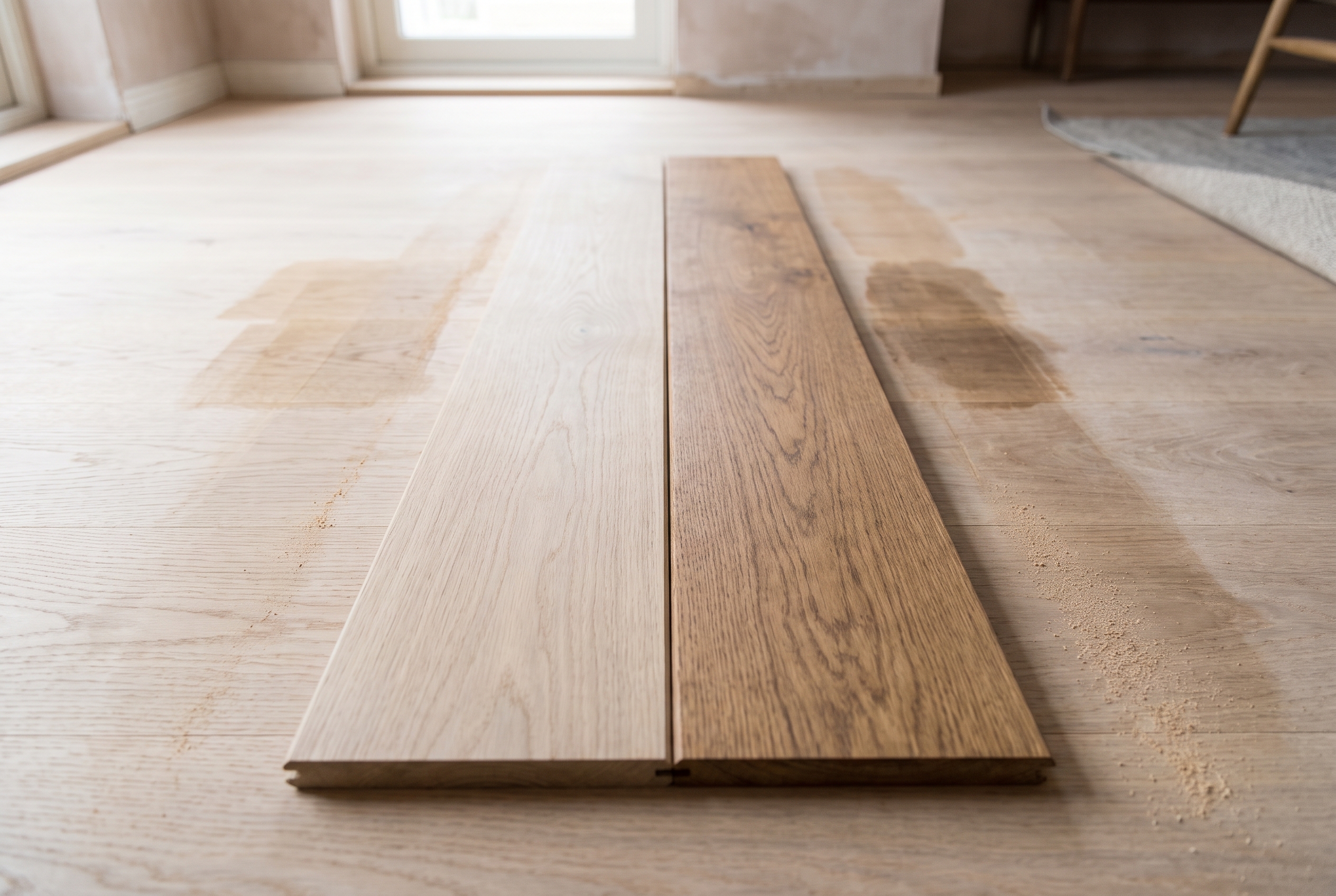
White oak is the oak for a light, natural, gray or beige floor and for a calmer, straighter grain. Red oak is the oak for a warm floor, for medium and dark stains that hide the difference anyway, for matching the red oak already in so many older houses, and for a smaller bill. For dents, dogs and daily wear the two are close enough that the finish you choose matters more than the species.
| If you want | Choose | Why |
|---|---|---|
| A light, natural or Nordic look | White oak | Red oak shows pink under light stains |
| A gray or greige floor | White oak | Gray picks up red oak's pink |
| A medium or dark brown stain | Either, and red oak costs less | Dark stains hide the difference |
| To match an existing oak floor | The same species | Each oak takes stain its own way |
| A grain that hides scratches | Red oak | Its bold, wavy grain disguises wear |
| Straight grain or ray fleck | Rift or quartersawn white oak | Its rays are longer and show more |
| The lowest price | Red oak | It's more plentiful, so it costs less |
How Are Red Oak and White Oak Different?
The difference between red oak and white oak is mostly color and grain, with only small gaps in hardness and price. Bruce's comparison of red and white oak flooring describes white oak as light brown to tan with beige tones, and red oak as pinkish-red to reddish-brown with salmon undertones; Bruce is one of the hardwood makers we carry. Under a clear finish, red oak looks warmer and rosier; white oak looks cooler, often with a faint olive cast.
The grain differs just as much. Red oak has a bold, wavy grain with tall arches, the "cathedrals" you see in most older oak floors. White oak's grain is straighter and quieter, and its rays, the thin ribbons that run across the grain, are longer, so they show as flecks when the log is cut the right way.
Inside the wood, the pores set them apart. White oak's pores are plugged with tiny bubble-like growths called tyloses, which is why white oak has been the barrel wood for centuries, while red oak's pores stay open. On hardness, the same Bruce guide puts white oak at 1360 on the Janka scale and red oak at 1290, about 5 percent apart.
| Trait | Red oak | White oak |
|---|---|---|
| Natural color | Pinkish to reddish brown | Tan to light brown, olive cast |
| Grain | Bold, wavy cathedrals | Straighter and calmer |
| Pores | Open | Plugged with tyloses |
| Janka hardness | 1290 | 1360 |
| Seasonal movement | Slightly less | Slightly more |
| Material price | Lower | Higher |
One common claim gets this backward: white oak isn't the steadier of the two. The species figures in NWFA's Hardwood Floors magazine give red oak smaller shrink-and-swell factors than white oak, so red oak moves a little less with the seasons. The gap is small, and both are stable, well-behaved floors.
How Can You Tell Which Oak Your Floor Already Is?
To tell which oak you have, look at the end grain where a board's cut end shows: at a heat register, a threshold or the edge of a stair. Red oak's pores are open, and with a magnifying glass you can see empty holes. White oak's pores are filled in, so its end grain looks solid.
Color helps too, even under an old finish. A floor with a pink or salmon cast is almost always red oak, and one with a tan, greenish or gray-brown cast is usually white oak. Long ray flecks, half an inch or more across the grain, point to white oak.
If the oak is under carpet, lift a corner in a closet, where the floor has been out of the sun and shows its own color. A flooring pro can also settle it with a drop of a chemical test on a hidden spot: white oak turns dark brown to black, red oak only slightly brown. In many houses built after World War II around here, the answer is 2-1/4-inch red oak strip.
Which Oak Looks Better With Each Stain Color?
The lighter the stain, the more the species shows through it, and the darker the stain, the less the choice matters. A pale stain brings out red oak's pink, and under espresso or ebony the two oaks look the same.
- Clear or natural: red oak reads warm and rosy, white oak tan and calm. This is where the choice shows most.
- Light, whitewashed or Nordic: white oak. Red oak's pink comes through pale stains and can look peach.
- Gray or greige: white oak. Gray over red oak can pick up the pink and turn slightly purple.
- Medium browns: either. Red oak stays a shade warmer, which suits a traditional room.
- Dark brown, espresso or ebony: either, and the cheaper red oak looks the same as white oak.
- Reactive or fumed looks: white oak. Its tannic acid reacts with certain treatments, which finishers use on purpose for custom colors.
The finish on top changes the color too. An oil-based polyurethane warms both oaks and pushes red oak toward orange as it ages. A water-based finish keeps white oak pale and cool, and leaves red oak looking pinker than it would under oil. A matte finish shows less of either effect than a glossy one.
Choose the stain on the floor itself. After sanding, stain a few patches about two feet square, put the finish over them, and look at them in morning light and again in the evening with the lamps on. A sample on paper, or on a different wood, tells you little; a patch on your own sanded floor tells you nearly everything.
Can Red Oak Be Stained Gray or to Look Like White Oak?
Red oak can get partway there: a darker gray-brown or greige can look close to stained white oak, but a light, cool gray usually picks up red oak's pink and reads lavender or muddy. The pink is in the wood's own color, so stain sits on top of it rather than replacing it.
Finishers have a few ways to get closer. A stain with a little green in it cancels some of the red. A darker gray hides more of the undertone than a light one. And the test patches, finished the same way the floor will be, show whether it worked before the whole room is stained.
When the look you want is a pale, cool white oak, starting with white oak is often cheaper in the end. A red oak floor stained light gray that disappoints has to be sanded again, which costs more than the difference between the two species.
Is White Oak Harder Than Red Oak, and Does It Matter for Dogs and Kids?
White oak is a little harder, 1360 on the Janka hardness test to red oak's 1290, and that 5 percent rarely shows in a house. A dog's nails or a dropped toy marks both oaks about the same. How a floor looks after five years of dogs and kids depends mostly on the finish, the sheen and the grain.
A hard factory finish resists scratches better than any finish brushed on in a house, so a prefinished oak floor is the tougher choice for a busy household. A matte or satin sheen hides the fine scratches that gloss shows off, and a wire-brushed texture hides wear in its own grooves. Red oak's busier grain is a disguise of its own, since a scratch across a wavy cathedral is harder to spot than one across straight, calm grain.
Habits do the rest of the work: felt pads go under every chair and table leg, a runner goes where the dog takes the corner, and nails stay trimmed. For a floor that will live with big dogs, the finish and texture you pick matter more than which oak is under them.
Which Oak Handles a Kitchen or an Entry Better?
White oak handles a kitchen or an entry modestly better, because its plugged pores slow water from soaking into the wood, the reason it was used for barrels and boats. Red oak's open pores let water in more easily at a cut end or a worn spot.
On a floor, though, water gets in at the seams between boards and through finish that has worn thin, not mainly through the pores. Neither oak is a waterproof floor. A spill wiped up quickly does no harm to either, and a leak that sits overnight cups the boards of both.
Mats in front of the sink, the dishwasher and the door do more than the species. At an entry, our winters bring salt and grit that grind a finish down, so a long walk-off mat and a damp-mop with plain water through the winter protect either oak. In a kitchen that swings between steam and dry winter heat, an engineered oak floor rides the humidity better than solid.
Do Red Oak and White Oak Change Color Over Time?
Both oaks darken and warm with light and age. Red oak drifts toward amber and orange, which is the look of many older floors, and white oak drifts toward a deeper gold-brown. The finish adds to it, since oil-based polyurethane ambers as it ages and a water-based finish stays clearer.
The change is slow and mostly even, so it shows only where a rug has sat for years and left a paler square. Moving rugs and furniture now and then keeps the color even. Blinds, sheer curtains or a UV-blocking window film on strong south and west windows slow the change.
When a pale, cool floor is the goal, a water-based finish keeps it that way longer. Many spec sheets also note how much a floor's color will shift in light, which is worth checking for a sunny room.
How Do Plain-Sawn, Rift and Quartersawn Oak Look Different?
The cut, meaning the way the log is sawn, changes an oak floor's look as much as the species does. Plain-sawn boards, the most common and least expensive, show the arching cathedral grain. Rift-sawn boards are cut at an angle to the growth rings and show tight, straight lines. Quartersawn boards are cut across the rings and show straight grain with shimmering flecks from the wood's rays.
White oak is the oak most often rift- and quartersawn, because its longer rays make the fleck bold. Live-sawn boards mix all three cuts across the floor for a natural, varied look; Appalachian Flooring's Alta Moda line, which we carry, includes a live-sawn white oak.
Grade changes the look as well. Select or clear grade has few knots and even color. Natural or No. 1 common has some color variation and small knots. Character or No. 2 common, and cabin grade, carry the knots, streaks and color swings of a rustic floor, and they cost less.
What Does Red Oak Cost Compared With White Oak?
White oak costs more for the same grade and width. HomeGuide's hardwood flooring cost guide puts red oak material at about $5 to $10 a square foot and white oak at $6 to $12. A solid hardwood floor of either runs about $11 to $25 a square foot installed, and the labor costs the same for both.
| Floor size | Red oak material | White oak material |
|---|---|---|
| 150 sq ft bedroom | $750 to $1,500 | $900 to $1,800 |
| 400 sq ft living and dining | $2,000 to $4,000 | $2,400 to $4,800 |
| 800 sq ft first floor | $4,000 to $8,000 | $4,800 to $9,600 |
On a 400 square foot living and dining room, white oak in the same grade adds roughly $400 to $800 in material. That's against about $4,400 to $10,000 for the whole floor installed. Red oak costs less because it's more plentiful, and white oak costs more because more people want it.
Grade, cut and width move the price far more than species. A quartersawn or wide-plank white oak can cost twice what plain-sawn strip of either oak does. Engineered oak is the cheaper way to a wide board: HomeGuide's engineered hardwood guide puts red oak at about $2 to $6 a square foot for material and white oak at $4 to $7. We price your rooms once the species, cut and width are settled, and our financing can spread the cost.
Can You Mix Red Oak and White Oak in One House?
Mixing red and white oak works in separate rooms with a threshold or a change of direction between them. In one continuous floor, new boards should match the old species, width and direction, because the two oaks take stain differently and the join would show.
When new oak meets an old red oak floor, there are three ways to make it work. The cleanest is to weave new red oak of the same width into the old floor and refinish the whole run to one color. The second is a threshold or a border board at a doorway, so each room can be its own oak. The third is a medium or dark stain on both, which hides the species.
Weaving in is done board by board. Old boards at the edge are pulled in a staggered, saw-tooth line so the new rows interlock with the old instead of meeting along a straight seam. The new boards have to match the old floor's width and thickness. They acclimate in the house until a moisture meter reads them within 2 points of the old floor, or 4 points for narrow strip. Then the old and new floor are sanded together and finished as one.
In an open plan, the old floor often runs from the living room into a kitchen or addition getting new flooring, and that's where weaving in pays off. Stairs follow the same rule, and stair treads stained to match carry the floor's color up the steps.
Why Did My Refinished Oak Floor Turn Pink, Blotchy or Green?
When a refinish goes wrong on oak, turning pink, blotchy or green, the stain and finish almost always didn't suit the species. These are the common surprises and what's behind them:
- Pink or peach: a light or natural stain on red oak. Red oak's own color shows through; a medium stain, or white oak next time, fixes it.
- Lavender or muddy gray: a cool gray on red oak. A warmer greige or a darker gray hides it after the floor is sanded again.
- Dark or discolored patches on white oak: tannin pulled out of the wood by a pale stain under a water-based finish. Trade magazines call it tannin pull, and the floor is sanded and refinished with a different stain and finish system.
- Orange: an oil-based finish ambering over red oak. A water-based finish stays clearer.
- Blotches and dark picture-frame edges: uneven sanding, or stain that pooled at the edges. A careful re-sand fixes it.
Test patches on the sanded floor prevent nearly all of these. The time to find out how an oak takes a stain is on two square feet, not two rooms.
We Sell and Install Both Oaks in Washington and Long Valley
At Washington Flooring, we sell red oak and white oak floors in solid and engineered construction, and our own crews install them. Appalachian Flooring's Alta Moda line comes in both oaks as solid strip and as engineered plank up to 7 inches wide, including a live-sawn white oak. Bruce, Mullican and Superior Hardwood Flooring are among the other makers on our floor. Both oaks are in our hardwood catalog, under the Wood Species filter, and its Surface Texture filter finds the wire-brushed ones.
Seeing the two side by side settles more than any photo, and both oaks are on display at our Washington and Long Valley showrooms. Questions about stain and species are what a free flooring estimate is for, and a project specialist from our team works through them room by room.
Questions We Hear About Red and White Oak
Is Red Oak Outdated?
No, red oak isn't outdated. The orange look people mean is usually an aged oil-based finish over red oak, and a new finish changes it. Under medium and dark stains, red oak looks the same as white oak and costs less.
What has changed is the taste for light floors. For a pale, cool look, white oak is the better starting point; for warm and mid-tone floors, red oak is as current as ever.
Which Oak Adds More Resale Value?
Neither oak adds more resale value by species. Buyers see a hardwood floor, and what they notice is its condition and its color, not whether it's red or white oak.
A floor in good shape, in a color that suits the house, does more for a sale than any species. A worn oak floor usually gains more from a fresh finish than from being torn out for a different oak.
Is Engineered White Oak Real White Oak?
Yes, engineered white oak is real white oak where you walk; only the core underneath is different, built from thinner layers that cross each other. It looks, stains and wears like solid white oak, since the surface is the same wood.
The difference is in what's underneath and what it allows. Engineered oak handles humidity swings and concrete subfloors better, while solid oak can be sanded more times over its life. The wear layer's thickness, listed on the spec sheet, tells you how many sandings an engineered floor has in it.
Can Red Oak or White Oak Go in a Bathroom?
Either oak can go in a powder room, with a mat at the sink and spills wiped up. A full bathroom with a tub or shower is a hard place for any wood, and tile or a waterproof floor is the better choice there.
If oak does go into a bath, white oak's closed pores give it a small edge, and an engineered board handles the steam better than solid.
Which Oak Is Used for Herringbone Floors?
Both oaks are used for herringbone, and white oak is the more common choice today for its calmer grain and the way it takes light stains. Red oak herringbone is warmer and costs less.
Any pattern costs more to install than straight planks, because every piece is cut and fitted by hand. HomeGuide puts true parquet patterns such as herringbone at about $13 to $40 a square foot installed.
Compare Both Oaks Next to Your Cabinets and Trim
The right oak is the one that looks right in your light, next to your cabinets, trim and furniture. Request a free estimate, and one of our project specialists will go over the rooms with you and show you both oaks in the stains you're considering.


