

On the Janka hardness scale, the dent-resistance test the flooring trade lives by, American black walnut measures 1,010 and the jatoba sold as "Brazilian cherry" measures 2,690. Two boards can sit side by side on the same showroom rack, one more than two and a half times harder than the other, under names that tell you almost nothing about which is which. A name on a hardwood sample is a marketing decision as often as a botanical one, and reading past it is how you avoid paying for a wood that won't hold up the way its label suggests. This guide translates the common flooring names back to the real species and what each one means for hardness, color, stain and price.
What the Janka Number Actually Measures
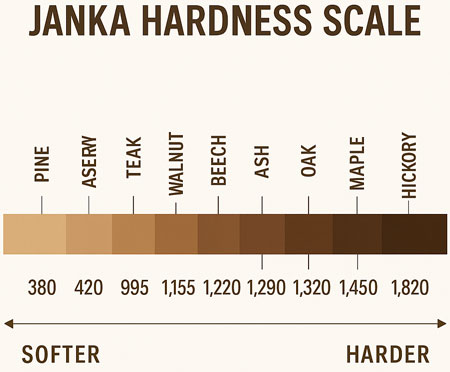
The Janka test measures how well a wood resists denting, and it's the one number that cuts through species marketing. It comes from a standard method, ASTM D143, written by the ASTM standards body for testing small, clear wood samples: a machine presses a 0.444-inch steel ball halfway into the wood and records the force in pounds it took. That force, in pounds, is the Janka rating, and a higher number means a harder wood that shrugs off dents and dings better.
Red oak is the yardstick most of the trade uses, so it's worth fixing in mind first. Red oak measures 1,290 pounds-force at 12 percent moisture, and because it's the most common wood floor in American homes, people tend to judge everything else against it. A wood well below 1,290 dents more easily; a wood well above it takes more of a beating before it shows. What Janka does not tell you is just as important: it says nothing about how a wood takes stain, how much it moves with the seasons, or how it looks. It predicts dents, and that's all. Treat it as one input in the decision, and read the rest of this guide for the parts it misses.
The Decoder: Marketing Names vs. the Real Wood
Most confusion at the sample rack comes from a handful of names that hide the actual species. Here is what the common ones really are, with the Janka hardness for each, so you can see at a glance which "exotic" floor is genuinely tough and which familiar-sounding one is softer than you'd guess.
Name on the sample | The real wood | Janka (lbf) | What it means for you |
|---|---|---|---|
Pacific pecan, pecan | Hickory (genus Carya) | 1,820 | Among the hardest domestic floors; wild grain, excellent in busy rooms |
Brazilian cherry | Jatoba (not a cherry) | 2,690 | Very hard; deep red that darkens with light over time |
American walnut, black walnut | Black walnut | 1,010 | Softer than oak; rich color, but shows wear sooner |
Red oak | Red oak | 1,290 | The baseline; open grain hides scratches, fights gray stains |
White oak | White oak | 1,350 | Slightly harder; closed grain resists moisture, takes gray and greige stains |
Acacia, Asian walnut | Acacia (a group of species) | Varies | A genus, not one wood; look and hardness change board to board |
"Pacific Pecan" Is Hickory, and That's Good News
Pacific pecan is hickory under a gentler-sounding name. Pecan and the hickories share a genus, Carya, and the flooring trade mixes and sells them together as hickory, so the pecan on a sample tag is one of the hardest and strongest woods native to the country. It measures 1,820 on the Janka scale, comfortably above both oaks. That hardness is why a pecan or hickory floor takes years of kids, chairs and dog nails without complaint.
The trade-off with pecan is character, and whether you want it. Hickory runs to dramatic grain and big swings between pale sapwood and dark heartwood, so a floor of it is lively rather than uniform. Its hardness also makes it slower to sand and nail on site, which is a fair thing to ask your installer about before you commit. If you want a calm, even floor, pecan may be busier than you pictured; if you want toughness with personality, few domestic woods beat it.
"Brazilian Cherry" Isn't Cherry
Brazilian cherry is jatoba, and it isn't a cherry at all. The wood is Hymenaea courbaril, and it bears little relation to the domestic cherry most Americans picture; the name rides on its reddish color rather than its species. What it does have is hardness: jatoba measures 2,690 on the Janka scale, more than two and a half times as hard as black walnut and among the toughest floors you can buy.
Two things follow from choosing jatoba, and both surprise people. It resists dents extremely well, which is the upside. It also photosensitizes, meaning it darkens noticeably as daylight reaches it over the first months in your home, so the board on the rack is lighter than the floor will settle into. If you love a deep, warm red, that shift is a feature worth planning your furniture around. If you expected the sample color to be the final color, it's a genuine catch, and area rugs left in place can leave lighter patches until the wood evens out.
The Walnut Surprise: A Prized Wood That Dents
Black walnut is the floor where the name oversells the toughness. American black walnut is one of the most sought-after woods for its chocolate-brown color and straight, calm grain, but it measures just 1,010 on the Janka scale, softer than red oak's 1,290. That doesn't make it a poor floor. It makes it a floor to match carefully to the room.
Where black walnut goes decides whether its softness ever matters. In a study, a formal living room or a main bedroom, it's a beautiful, gently aging floor that will look better for the light traffic. Put the same wood under a kitchen chair that scrapes back three times a night, or along a hallway a big dog runs, and it will collect dents and scratches sooner than oak or hickory would. Buyers who assume a rich, high-end look must mean a hard-wearing floor are the ones caught out here, and it's worth knowing before the boxes arrive.
Red Oak vs. White Oak: Same Family, Different Floor
Red oak and white oak sit close together on hardness but behave differently where it counts. Red oak measures 1,290 and white oak 1,350, so the dent resistance is nearly a wash. Hard maple, for comparison, sits higher at 1,450, harder than either oak, which is why it turns up on gym floors and bowling lanes. The real split between the two oaks is in the pores. White oak's heartwood is full of tyloses, tiny bubble-like structures that plug the wood's pores, while red oak lacks them and leaves its pores open. Those plugged pores are why white oak is used for wine barrels and boat building, and why it handles spills and damp better than red oak does.
For a floor, that same difference decides color. White oak's closed, even grain takes the gray, greige and whitewashed stains that are everywhere in new homes right now, holding them cleanly. Red oak carries a pink undertone and an open grain that fights those cooler colors, often pulling them warm or blotchy. Both are excellent, honest floors. Which "oak" you want depends less on hardness than on the color you're chasing and how much moisture the room sees.
The Labels That Aren't Species at All
Some words on a hardwood sample describe how the board was built or finished and say nothing about the tree. "Engineered" is a construction: a real-wood top layer bonded over a plywood-style core, and it can be almost any species on top, which is why you can find solid and engineered hardwood in the same species side by side. "Distressed," "hand-scraped" and "wire-brushed" are surface textures. "Character" or "rustic" grade means more knots and color variation, which is a look and a price point rather than a species.
Reading a sample tag well comes down to finding two things. Look for the actual species and the grade, because together those settle hardness, price and how busy the floor will look far better than the trade name printed largest. If a tag gives you a poetic name and no species, that's your cue to ask.
Why the Name on the Sample Matters for Your Budget
The species behind the name drives three things the marketing can hide: how well the floor resists dents, how it takes color, and what it costs. A softer wood in a hard-traffic room means dents you'll notice within a year; a wood that photosensitizes means a floor that won't match the sample by spring; an oak chosen for a gray stain it can't hold cleanly means a color you didn't want. None of those are the wood's fault. They come from buying a name instead of a species.
The honest way to shop is to ask for the botanical species and the grade on any sample you like, then weigh its Janka number against the traffic the room actually sees. Our staff at our Washington and Long Valley showrooms can name the real species behind any sample and tell you how it will wear, and you can browse the hardwood we carry by species rather than by slogan.
Questions We Get About Hardwood Names
Is "pacific pecan" real pecan?
Pacific pecan is pecan, and pecan is a hickory. Pecan and the hickories share the Carya genus and are milled and sold together as hickory, so a pacific pecan floor is a genuine domestic hickory, and a hard one at 1,820 on the Janka scale.
Is Brazilian cherry actually cherry?
Brazilian cherry is not cherry. It's jatoba, a tropical hardwood whose reddish color earned it the cherry name, and at 2,690 on the Janka scale it's far harder than any domestic cherry. Expect it to darken with light exposure over its first months in your home.
What is the hardest common wood floor?
Among the woods you'll see most often, jatoba, sold as Brazilian cherry, is the hardest at 2,690 on the Janka scale, with hickory and pecan next at 1,820. Both are well above red oak's 1,290, which is why they hold up in the busiest rooms.
Does a higher Janka number mean a better floor?
A higher Janka number means a harder floor, but not automatically a better one. Janka predicts dent resistance only. It tells you nothing about how a wood takes stain, how it moves in a dry winter, or whether its look suits your room, so a softer wood is often the right call in a low-traffic space.
What is acacia flooring?
Acacia is a group of species, not a single wood, so acacia flooring varies a lot from batch to batch in color, grain and hardness. It's sometimes sold as "Asian walnut." If you like a particular acacia sample, ask which species it is and how hard that one tests before you buy a whole floor of it.
Choosing the Right Wood for Your New Jersey Home
The best hardwood floor is the one whose real species fits how your rooms actually live, and that's rarely the one with the fanciest name. Match a harder wood like hickory or white oak to the kitchen, the hall and the family room; save a softer beauty like black walnut for the quieter spaces where its color can age in peace. We're a family-owned shop that has fitted Warren and Hunterdon County homes for decades, and we'd rather tell you a sample is softer than it looks than sell you a floor that disappoints. When you're ready, request a free in-home estimate and we'll bring samples, name the species on every one, and match hardness, color and budget to your rooms.


