


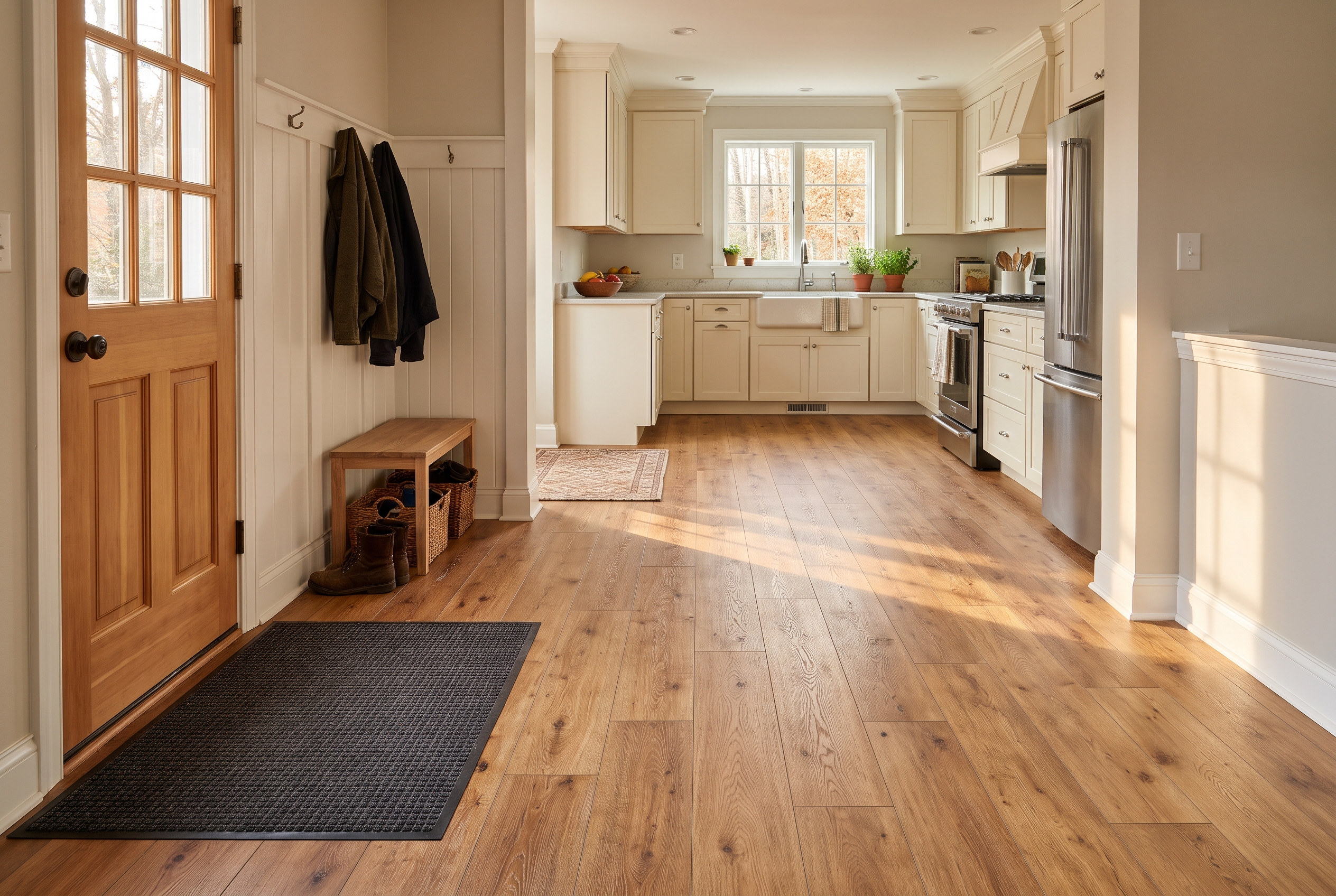
AC3 laminate has all the wear resistance a bedroom, living room or upstairs hall will ever use. Step up to AC4 for a kitchen, an entry, or a house where a dog and outdoor grit cross the floor every day, and leave AC5 to shops and offices. The rating only measures how long the printed wood pattern holds out against grinding, though, so the core, the locking joint and the water rating decide the rest of a laminate floor's life.
| Room | AC rating to buy | Also check |
|---|---|---|
| Bedroom or guest room | AC3 | Felt pads under furniture |
| Living or dining room | AC3, or AC4 with a dog | A textured, low-gloss surface |
| Upstairs hallway | AC3 or AC4 | A runner where traffic turns |
| Kitchen | AC4 | A waterproof or water-resistant line |
| Entry or mudroom | AC4 or AC5 | A walk-off mat and a waterproof line |
| Finished basement | AC3 or AC4 | A dry slab and a vapor barrier |
| Home office | AC4 | A mat under the rolling chair |
What Does an AC Rating on Laminate Actually Measure?
An AC rating measures how much grinding a laminate surface takes before its printed pattern wears through. AC stands for abrasion class, a scale set by EN 13329, the laminate standard written in Europe. In the test, abrasive wheels turn on a sample until the print starts to wear away, and the number of turns sets the class.
Each step up the scale is a real step. An AC4 surface has to survive about twice the grinding an AC3 surface does, and AC5 about half again more than AC4. Most laminate sold for homes now is AC3, AC4 or AC5, since AC1 and AC2 have mostly left the market.
North America has its own laminate standard, and it doesn't use AC classes at all. The North American Laminate Flooring Association (NALFA) certifies floors to its LF-01 standard and has said plainly that the AC rating spread through marketing even though LF-01 doesn't use it. You'll find an AC number on nearly every carton, and a NALFA seal on some.
What Do the AC Classes and Use Classes on a Carton Mean?
AC1 through AC5 run from light bedroom use to heavy commercial traffic. Many cartons print a second number beside the AC class: a two-digit use class from EN 13329 that says where the floor is built to go. The European Producers of Laminate Flooring (EPLF) sorts the use classes this way.
| Use class | Intended use | Example rooms |
|---|---|---|
| 21 | Light home use | Bedrooms, guest rooms |
| 22 | Average home use | Living room, dining room, hallways |
| 23 | Heavy home use | Stairways, entry halls, kitchens |
| 31 | Light commercial use | Hotel rooms, small offices |
| 32 | Average commercial use | Offices, stores, waiting areas |
| 33 and 34 | Heavy commercial use | Large offices, malls, classrooms |
A floor rated 32 or 33 is built for a business, and in a house that extra capacity turns into extra years. Most laminate sold for homes carries one of those two classes for that reason.
What Does the AC Rating Not Tell You?
Scratches, dents, stains, sunlight and water are all outside what an AC rating measures. It covers one thing, abrasion through the print, though it's often described as if it covered everything. North America's LF-01 standard tests the rest one at a time: impact, stains, light resistance, moisture, a rolling chair, a scratch test and, as an option, how the joints swell when water sits on them.
That matters because abrasion is rarely what ends a laminate floor in a house. Fine scratches from grit dull the top, a dropped pan chips an edge, and water that reaches a seam swells the core. Whether a floor shrugs those off comes down to its core, its joint and its water rating.
Treat the AC rating as one line on the spec sheet. The core, the joint, the water rating and the surface texture are the other lines that decide how the floor looks in ten years.
Which AC Rating Does Each Room Need?
AC3 covers every room in most houses, and AC4 adds margin where grit and water come in. EN 13329 says as much, since its heaviest home-use class, 23, is meant for stairways, entry halls and kitchens. Choosing AC4 for those rooms buys a floor built for heavier use, which lasts longer and takes a bad winter in stride.
Guides split on this point, with some telling everyone who has a pet to buy AC4 or better throughout and others calling AC3 plenty for any home. Both are right for some houses. A quiet house with no dog and shoes off at the door gets all it needs from AC3. A house where the side door opens into the kitchen and a dog runs that path all day is an AC4 house.
In an open floor plan, buy one rating for the whole run. A floor that flows from the kitchen into the living room can't change products at an invisible line, so the busiest room in the run sets the rating for all of it.
What AC Rating Does a Kitchen Need?
A kitchen needs AC4 and, more than that, a line rated waterproof or water-resistant. Kitchen chairs drag, grit comes in from the back door, and the sink and dishwasher drip. Water matters most, because it's what swells laminate at the seams.
Felt pads under every chair and stool take care of the dragging. A mat in front of the sink and the dishwasher catches the drips you don't see, and spills get wiped up when they happen.
What Laminate Holds Up in an Entry or Mudroom?
An entry or mudroom calls for AC4 or AC5, a waterproof line, and a walk-off mat that catches grit before it reaches the floor. Our winters bring road salt, sand and slush through the door for months, and that grit acts like sandpaper under a boot.
The mat does more than the rating. One long enough for two full steps catches most of what a boot carries in. Salt leaves a white film as it dries, so damp-mop the entry with plain water once a week through the winter and dry it after.
Does the AC Rating Matter in a Basement?
In a basement, moisture matters more than the AC rating. A basement family room gets ordinary home traffic, so AC3 or AC4 is plenty. What decides whether laminate lasts down there is the slab: it has to test dry and have a vapor barrier over it, and the room's air has to stay dry, usually with a dehumidifier in summer.
If the basement has ever taken on water, choose a waterproof line. A flood that sits under any floor is still a replacement job, so a sump that runs every storm is a reason to think hard about any floor down there.
Can Laminate Handle a Rolling Desk Chair?
Yes, in a home office an AC4 laminate under a chair mat handles a rolling chair for years. Hard plastic casters grind whatever grit is under them into the same small circle all day, which is the same wear the AC test measures.
A clear chair mat stops it completely. When a mat isn't practical, soft rubber casters made for hard floors cut the wear a great deal, and a quick sweep under the desk once a week takes care of the grit.
What AC Rating Should You Get With Dogs, Kids or Tenants?
Dogs and tenants call for AC4, while kids are a reason to care about the core and thickness more than the rating. Each household wears a floor differently, and each needs something the AC number doesn't show.
Which Laminate Holds Up Best to Dogs?
For dogs, choose AC4 with a textured, low-gloss surface and a waterproof or water-resistant core. Claws leave fine scratches in the top coat, and a textured, matte surface hides them where a smooth, glossy one shows every mark. The Pet Friendly filter in our laminate catalog narrows the choice to lines tagged for pets.
Accidents are a bigger risk than claws, because urine that sits in a seam can swell it. Wipe it up fast, then clean the spot with a damp cloth and a cleaner made for laminate, the first rule of cleaning up after a dog on any hard floor. Keep nails trimmed, and put a runner where the dog takes the corner at full speed.
Will Laminate Dent Under Dropped Toys and Furniture?
Toys rarely mark laminate, but a heavy drop can chip an edge or dent a thin plank. The surface is hard enough that everyday toys bounce off it. What gives under a dropped cast-iron pan is the core beneath the surface, and a thicker, denser core takes the blow better.
Furniture leaves its marks more slowly: a heavy dresser on small feet presses into the floor over years, so use wide felt pads, and lift furniture to move it instead of pushing it.
What Laminate Lasts in a Rental?
A rental wants AC4 laminate, a waterproof or water-resistant line, and a mid-tone color with some texture to hide wear. Tenants won't always use mats or wipe spills, so the floor has to forgive both.
Use the same product in every unit and keep spare cartons, since a matching plank from the same line is what makes a repair invisible. A floor that has been discontinued can't be matched later.
Does Thicker Laminate Last Longer?
Thicker laminate doesn't last longer in wear, because a 12 mm plank carries the same thin top layer as an 8 mm one and resists scratching no better. Thickness, usually 7 to 12 mm, changes how the floor feels and sounds, how it handles a dropped pan, and how it bridges a small dip in the subfloor.
A 12 mm plank feels firmer and quieter underfoot, closer to real wood, and its thicker core takes heavy impacts better. It also rides over small hollows in a subfloor that would let a thinner plank flex at the joints. An 8 mm plank does the same job in a bedroom over a flat floor for less money.
Upstairs, the thickness and the pad under it decide how much of your footsteps the room below hears, so a thicker plank or a better sound pad is worth it over a bedroom ceiling. Some planks come with the pad attached, and the thickness on the carton may include it. Never lay a second foam pad under a plank that already has one; the joints flex on the soft layer and open up.
Thickness also raises the price. In HomeGuide's guide to laminate installation costs, a 7 to 8.9 mm laminate runs about $0.80 to $3.50 a square foot for the material, and an 11 mm-and-up plank about $2 to $5. Twelve Oaks puts the thickness right in the name of its 12mm Collection, one of the lines we carry.
How Much More Does AC4 or AC5 Laminate Cost?
Laminate costs about $4 to $14 a square foot installed nationally in the same HomeGuide guide, with the material $1 to $6 of that and labor $3 to $8. A higher AC rating, a thicker plank, water resistance and an attached pad all push a floor up within that material range.
| Floor size | Installed, national range |
|---|---|
| 150 sq ft bedroom | $600 to $2,100 |
| 250 sq ft kitchen | $1,000 to $3,500 |
| 500 sq ft open first floor | $2,000 to $7,000 |
Nobody publishes a set premium for AC4 over AC3, because the rating usually travels with thickness, water resistance and a maker's better finishes. Thickness shows the size of the step. In a 250 square foot kitchen, an 8 mm floor's material comes to about $200 to $875 at HomeGuide's prices, and a 12 mm floor's about $500 to $1,250, before installation.
An attached pad raises the plank's price and removes a separate underlayment from the job, so compare quotes with the pad counted on both sides. Removing the old floor and leveling the subfloor move a quote more than the rating does. Your price from us comes once the rating for each room is settled, and our financing spreads the payments.
Why Do the Core and the Locking Joint Matter as Much as the AC Rating?
Water and weight get into a laminate floor through the core and the joint, and that's how most laminate floors end. A laminate plank is a printed layer under a clear top coat, pressed onto a core of high-density fiberboard, and the four layers of a laminate plank each do a different job.
The core is the plank's body. A denser fiberboard core holds the joint's shape, resists dents, and swells less when water reaches it. Many newer lines treat the core or seal its edges so water can't wick in at the seams.
The locking joint holds the floor together. A tight, well-milled joint keeps planks from separating, keeps the seams closed against spills, and keeps the edges level so they don't chip. Laminate's wood-fiber core needs its joints and coatings to keep water out, the main difference from luxury vinyl's synthetic core, which doesn't swell.
Is Laminate Waterproof or Only Water-Resistant?
It depends on the line: some laminate is built and sold as waterproof, and the rest is water-resistant for a set time. The maker's water rating on the carton says which, and for how long.
A water-resistant floor handles a spill wiped up within the time its maker states, often a matter of hours. A waterproof laminate keeps standing water out of its joints for longer, and the maker's warranty usually covers it. Neither is meant to sit in a flood, and water that runs under a floor from a burst pipe is trouble for any floor.
Read the maker's water rating rather than the word on the box. It tells you how long water can sit, and whether the claim covers the joints or only the surface. For a basement that has flooded, a full bathroom or a laundry room, choose a waterproof floor.
How Long Does Laminate Flooring Last?
Laminate flooring lasts about 25 years on average in a home, and floors built to a commercial use class last longer. EPLF's technical bulletin on laminate lifespans puts a class 23 floor at 15 years at the least and 25 on average. A class 32 floor runs 20 and 30 years, and a class 33 floor 25 and 35.
Those figures assume the floor went in and was cared for the way its maker says. What moves a floor up or down the range is how well its rating matches the room, how much grit and water reach it, how well its joints hold, and how flat the subfloor is.
A floor is finished when its traffic lanes have dulled past the point of cleaning, or when the print has worn through at the doorways. Swollen seams in more places than a few spare planks can fix mean the same thing.
What Wears Out First on Laminate, and Can It Be Fixed?
Fine scratches and a dull path where people walk usually show first, and most other damage on laminate can be fixed by replacing planks. These are the common signs, roughly in the order they appear, with the fix for each.
- A dull path or haze: often it's residue from the wrong cleaner, not wear. Oil soaps, wax and polish leave a film on laminate. Mop with plain warm water on a well-wrung microfiber mop; if the shine comes back, it was residue, and if it doesn't, the top coat is worn there.
- Fine scratches: grit under shoes and claws. They can't be sanded out, but a walk-off mat and regular sweeping keep new ones from forming.
- A chip or a deep scratch: a dropped object. A laminate repair kit's colored wax or putty fills small ones so they disappear at standing height.
- A swollen or peaked seam: water reached the core. Dry the area, find the source, and replace the swollen planks, because swelling doesn't go back down.
- A gap between planks: a joint has let go, often over a dip in the subfloor. The planks can be tapped back together with a tapping block, but a gap that keeps opening means the subfloor needs attention.
Replacing a plank is easier on a floating floor than people expect. Near a wall, the rows are unclicked back to the damaged plank and clicked back in with a new one. In the middle of a room, the damaged plank is cut out and a new one is glued in its place. Either way you need a matching plank, so keep a carton or two from the original order, stored flat and dry.
What Should You Check on a Laminate Carton Before You Buy?
On a laminate carton or spec sheet, check the AC rating and use class, the thickness, the water rating, the certification and the warranty, then test a sample at home. Each line tells you something different:
- AC rating and use class: the traffic and the rooms the floor is built for.
- Thickness: and whether that number includes an attached pad.
- Water rating: waterproof or water-resistant, and for how many hours.
- A NALFA seal: the floor passed North America's full set of laminate tests.
- Locking system: the maker's name for its joint, and how it goes together.
- Warranty: the residential term, and whether water damage is covered.
When two samples sell at a similar price, that list breaks the tie. Take the higher AC rating if everything else matches; when the ratings match, take the better water rating, then the thicker core, then the certification, then the texture you like.
Then put the sample through what your house will do to it. Drag a key across it, and grind a pinch of sand into it under your shoe. Lay two pieces side by side, pour a little water on the seam, and check it after the hours on the water rating.
Last, leave a piece in a sunny window for a few weeks next to one kept in a drawer. A sample that comes through your own tests has told you more than the carton did.
We Sort Our Laminate by AC Rating and Water Protection
At Washington Flooring, we carry laminate from Mohawk Flooring, Inhaus, Chesapeake Flooring, SFI, Twelve Oaks and Eternity Floors, among others, and our own crews install it. The AC Rating filter in our laminate catalog sorts the planks by class. Its Water Protection filter splits waterproof lines from water-resistant ones, so you can narrow the choice for each room before you come in.
A few lines show the range. Inhaus makes its Lamdura laminate in several collections, from Visions to Landmark. Mohawk Flooring's Adler Creek and Hampton Villa are among the Mohawk laminate lines we stock, and Eternity Floors' Cabana Collection is another on our floor.
When you're ready, one of our project specialists will go over the rooms with you at a free flooring estimate and match a rating to each one. We're a family business that has served Warren and Hunterdon counties for nearly 30 years, and you'll find samples at our Washington and Long Valley showrooms.
Questions We Hear About Laminate Durability
Is Laminate More Durable Than Hardwood?
On the surface, laminate is more durable than hardwood: its factory top coat resists scratches better than a wood floor's finish, and it doesn't dent as easily as softer woods. Day to day, a laminate floor shows less.
The difference is what happens when it wears out. A worn hardwood floor can be sanded and refinished, while a worn laminate floor is replaced. Laminate wins on daily scratches, and hardwood wins over the decades.
Does Sunlight Fade Laminate?
Sunlight fades good laminate very little, and certified floors are tested for light resistance before they earn the seal. Real wood changes color in the sun far more than laminate does, darkening or lightening in the first year.
Strong sun for years can still change any floor. Blinds or sheer curtains on south- and west-facing windows protect the floor along with the furniture, and moving rugs now and then keeps the color even.
Does a Higher AC Rating Mean a Longer Warranty?
Often a higher AC rating comes with a longer warranty, though not always. Makers usually give their higher-rated lines longer residential terms, and some add water coverage on their waterproof lines.
The terms differ from line to line, so the warranty booklet in the carton is what a claim is judged by. Keep it with your spare planks and the receipt, and register the floor with its maker if the booklet asks you to.
Tell Us the Rooms and We'll Match the Rating
The right rating comes from your rooms and your household, so start with a list: which rooms, which doors lead outside, and who walks on the floor. Request a free estimate, and one of our project specialists will match a rating, a water rating and a line to each room.


