


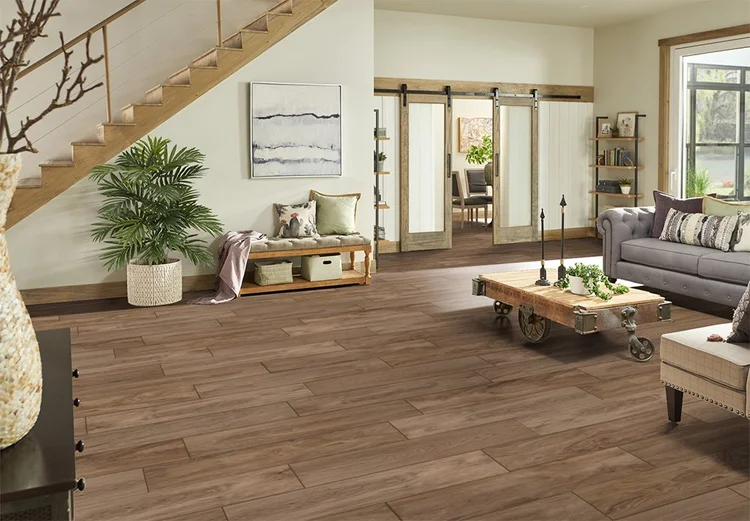
The clear top layer on a quality laminate plank is armored with aluminum oxide, the mineral geologists call corundum, which rates a 9 on the Mohs hardness scale and can scratch almost anything softer than itself. That's why a good laminate floor can take a hallway's worth of grit and dog nails and still look new. Toughness is the easy part, though. What makes a plank actually pass for hardwood is something you can see and feel on the showroom rack: whether the texture under your hand lines up with the grain in the picture. This guide explains what drives that realism and how to judge it before you buy.
What a Laminate Plank Is Actually Made Of
A laminate plank is built from several thin layers pressed into one board, and knowing them tells you where the realism lives. On top is a clear wear layer, usually loaded with aluminum oxide, that protects everything beneath it. Under that sits the decorative layer, which is a high-resolution photograph of real wood, and that photo is the entire wood look. Below the photo is a dense core of high-density fiberboard, the HDF that gives the plank its stiffness and holds the click-together edges. A backing layer underneath keeps the whole thing flat and balanced.
The decorative photo is the part that decides whether a floor convinces, so it's worth understanding what protects it and what proves it. The wear layer's aluminum oxide keeps foot traffic from scrubbing the printed image away, which is why a cheap, thin wear layer shows bald patches in a few years while a good one holds its picture for decades. To know a floor's picture and surface have actually been tested, look for NALFA certification. A NALFA-certified plank has passed the North American Laminate Flooring Association's ANSI/NALFA LF-01 standard, the trade group's third-party program that checks a floor for wear, impact, light and moisture resistance, staining, surface bond and dimensional stability. In plain terms, the seal means an independent lab confirmed the look will hold up.
The One Feature That Makes Laminate Look Real: Embossed in Register
Embossed in register is the single feature that separates convincing laminate from the plastic-looking kind, and it's easy to check by hand. An embossed-in-register plank has its surface texture pressed so the grooves, grain lines and knots you feel line up exactly with the printed grain you see. Run a finger across a good one and you feel a shallow dip where the picture shows an open pore, and a raised ridge along a grain line. Your eye and your hand agree, and that agreement is what the brain reads as real wood.
Cheaper laminate skips that alignment, and once you know the tell you can't miss it. A standard-embossed plank wears a generic texture, often a faint pebble or a repeating wood-grain pattern, that has nothing to do with the photo underneath, so a knot in the picture sits under a smooth or randomly bumpy surface. A fully smooth plank gives the game away even faster under raking light, reading as a laminated photo of a board. When you shop, put your fingertips on the plank and follow a knot or a long grain line. If the texture tracks the picture, the floor is embossed in register, and it will hold up to a close look in your living room.
How to Judge the Printed Look
The decorative layer is a photograph, so realism also depends on how good that photograph is and how often it repeats. Better laminate lines are printed from many different board images, so you rarely see the same knot twice across a room. Budget lines reuse a handful of images, and the eye quickly catches the same distinctive knot or streak appearing every few rows, which instantly reads as fake. Real hardwood never repeats, so repetition is the giveaway your floor is printed.
Two more details separate a believable plank from a flat one. Beveled edges, the small grooves milled along each plank's sides, define one board from the next so the floor reads as individual planks rather than one printed sheet; the trade-off is that deep bevels catch a little dust and need sweeping. Sheen is the other. A matte or low-gloss surface behaves like a real wood finish and hides scuffs, while a high-gloss laminate throws back light in a way no modern wood floor does and shows every footprint. To judge both, lay several planks together on the floor, step back, and look for repeats and for the way the light sits on the surface.
Choosing a Wood Look That Suits Your Room
The most convincing laminate is the one whose look fits your room's light and use, and for most New Jersey homes an oak look is the safest, most flexible choice. Oak reads as a familiar, natural floor in almost any style, and its grain gives the print plenty of character to work with. Lighter oak and greige tones make a room feel larger and hide dust and pet hair between cleanings, which is why they dominate new construction. Deep walnut and near-black looks are dramatic, but they show dust, crumbs and fine scratches far more, so they ask for more upkeep in a busy house.
Whatever tone you lean toward, judge it in your own light before you commit. A plank that looks warm under the showroom's lights can read gray in a north-facing room, and a busy grain that seems characterful on a single sample can overwhelm a whole floor. Take samples home, lay them where the floor will go, and look at them in morning and evening light. The look you can live with for fifteen years is worth an extra week of deciding.
Does the Realistic Look Actually Last?
A realistic laminate is only worth buying if the look survives traffic and sunlight, and that durability is exactly what third-party testing measures. The wear layer does the physical protecting, and because its aluminum oxide rates a 9 on the Mohs hardness scale, it resists the grit and nail scratches that would otherwise scrub through the printed image. Fade is the other threat, since a sunny room can wash the color out of a poorly made floor over a few years.
NALFA certification earns its place on the box for exactly this reason. The ANSI/NALFA LF-01 standard tests a plank's resistance to abrasive wear and to light, among other things, so a certified floor has proven in an independent lab that both its texture and its printed color will hold. When two planks look equally convincing on the rack, the certified one is the safer bet that it will still look that way after a decade of sun and shoes. Ask whether a floor you like is NALFA-certified, and treat it as a tiebreaker.
Questions We Get About Realistic Laminate
Does laminate really look like real wood now?
Good laminate now looks convincingly like wood, thanks to high-resolution printed grain paired with a surface texture embossed in register with that print. The trick is knowing which planks have that alignment. A budget laminate with a generic texture and an obvious repeating pattern still looks fake, so the category ranges widely.
What is embossed in register?
Embossed in register means the plank's felt texture is pressed to line up precisely with the printed image, so you feel a groove where you see a grain line and a dip where you see a knot. That alignment is the biggest single reason a laminate floor reads as real wood rather than a photo of it.
Is matte or glossy laminate more realistic?
Matte and low-gloss laminate looks more like real wood. Modern wood finishes are low in sheen, so a matte laminate matches what your eye expects, and it hides scuffs and footprints. High-gloss laminate reflects light in a way no current wood floor does, which reads as plastic and shows every mark.
Will I see the same plank image repeated across my floor?
Whether you see repeats depends on how many unique board images the laminate uses. Better lines print from a large set of images, so repeats are rare and easy to miss; budget lines reuse a few, so a distinctive knot shows up every several rows. Ask how many decors a product has, or lay out a dozen planks and look for the same board twice.
How can I spot a cheap laminate in the store?
You can spot a cheap laminate in a minute at the rack. Feel for texture that ignores the printed grain, look for an obvious repeating pattern and a high-gloss shine, and check whether the planks are beveled. Then ask if it's NALFA-certified. A floor that fails those checks may look fine under store lights and disappoint at home.
See the Difference in Person
Laminate realism is something you judge with your hands and eyes, which is why a showroom beats a screen every time. Come feel the difference between an embossed-in-register plank and a standard one, and you'll shop with a sharper eye afterward. You can browse the laminate we carry to see the oak looks and finishes available, and read up on how laminate compares with luxury vinyl if you're weighing the two. Better yet, bring a paint chip or a cabinet door to our Washington and Long Valley showrooms and match a floor to your room in person. When you've found a look you love, request a free in-home estimate and our crews will measure up and get it installed right.


