

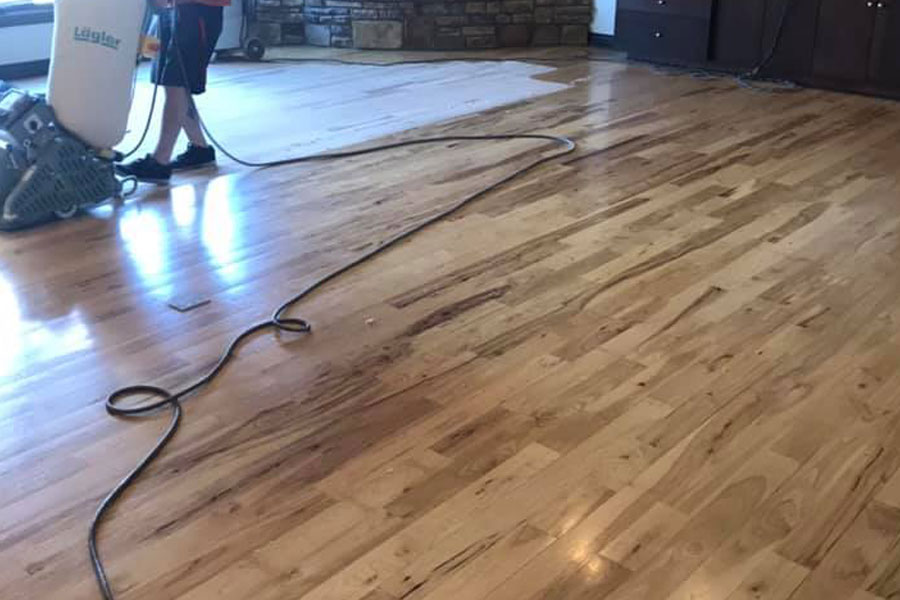
You pull back the area rug in the living room and wince. The finish is worn down to bare wood in the traffic lanes. Near the front windows, the boards have faded to a completely different color than the rest of the floor. And that dark stain by the baseboard — the one from the ice dam three winters ago — hasn't faded one bit.
Now you're stuck with the question every Hackettstown homeowner with older hardwood eventually faces: can these floors be saved, or is it time to start over?
The answer isn't always obvious. But understanding what refinishing can and cannot fix will save you from either wasting money on a lost cause or tearing out floors that had decades of life left in them.
When Refinishing Is the Smart Move
Refinishing works by sanding away the top layer of wood — finish, stain, and a thin fraction of the wood itself — to reveal fresh material underneath. Then a new stain and protective coat go on, and the floor looks nearly new.
This process only works when the damage lives on the surface. Scratches from chairs and pet claws, dulling from years of foot traffic, fading from UV exposure near windows — all of these sit in the finish layer. Sand them off and the problem disappears with them.
Solid hardwood floors can typically be refinished three to five times over their lifespan, sometimes more if the planks are particularly thick. Many older Hackettstown homes — those Victorians and mid-century ranches built when builders used genuine ¾-inch solid oak — still have enough wood above the tongue-and-groove to handle another round.
The cost difference matters too. Refinishing typically runs a fraction of what full replacement costs, making it the clear choice when the wood underneath is still sound. A professional assessment can tell you definitively how far gone your hardwood actually is before you commit either way.
When Replacement Becomes the Only Option
Some damage refinishing simply cannot reach. Water intrusion — whether from that ice dam, a leaky dishwasher, or spring snowmelt tracked through the mudroom — seeps deep into the wood fibers. The result is cupping, crowning, or boards that have actually begun to rot. Sanding the surface does nothing for wood that's compromised all the way through.
Then there's the thickness problem. If your floors have already been refinished once or twice, the remaining wear layer may be too thin to sand again without exposing the tongue-and-groove joints. The same applies to engineered hardwood with a thin veneer — once you've sanded through it, you're looking at the plywood core.
The Highlands climate adds another layer to this decision. The dramatic humidity swings between dry winter heating and damp summer air cause solid hardwood to expand and contract aggressively. If your existing floors have developed persistent gaps that open every January despite proper humidity management, replacement with engineered hardwood — which handles dimensional change far better — may solve the problem permanently rather than just cosmetically.
Structural issues beneath the floor are the final dealbreaker. Spongy spots, excessive squeaking that tightening from below can't fix, or subfloor damage all require pulling up the hardwood to address what's underneath.
Making the Call in Your Home
Start by examining the worst areas. If the damage is concentrated in one or two rooms while the rest of the house looks decent, spot replacement with matched new hardwood may bridge the gap between refinishing everything and a whole-house tear-out.
Consider your timeline. Refinishing creates dust and fumes and puts rooms out of commission for several days. Replacement takes longer but lets you change species, plank width, and stain to something that better fits how you live now — something worth weighing if you've never loved the honey-oak look you inherited from the previous owners.
The safest move is having someone who works with hardwood daily take a look. What looks catastrophic to you — deep scratches, a grayed-out patch near the slider — may be entirely fixable. What looks minor — a slight ripple you've learned to ignore — may signal subfloor trouble. Professional installation expertise means the difference between guessing and knowing.
The Bottom Line
Refinishing saves floors that are structurally sound but cosmetically tired. Replacement solves problems that go deeper than the surface — water damage, thin wear layers, and climate-driven dimensional instability that sanding alone can't fix. The right call for your Hackettstown home depends on what's actually happening beneath your feet, not just what you can see from above.
Stop by the Washington or Long Valley showroom to talk through your specific situation, or schedule your free estimate and we'll come assess your floors in person.


